Agree the operating contract
Map workloads, environment differences, release responsibilities, and current recovery assumptions. Define acceptance for deployment, observability, and handover before choosing the implementation detail.
A fictional platform engagement connecting repeatable environments, controlled delivery, and recovery practices for an expanding digital service.
Discuss a similar challengeA digital service with multiple application teams, inconsistent environments, and releases that depend on manual coordination.
10-week illustrative engagement
Platform & release foundations
Fictional engagement. All figures are simulated or illustrative design targets; they are not verified client results.
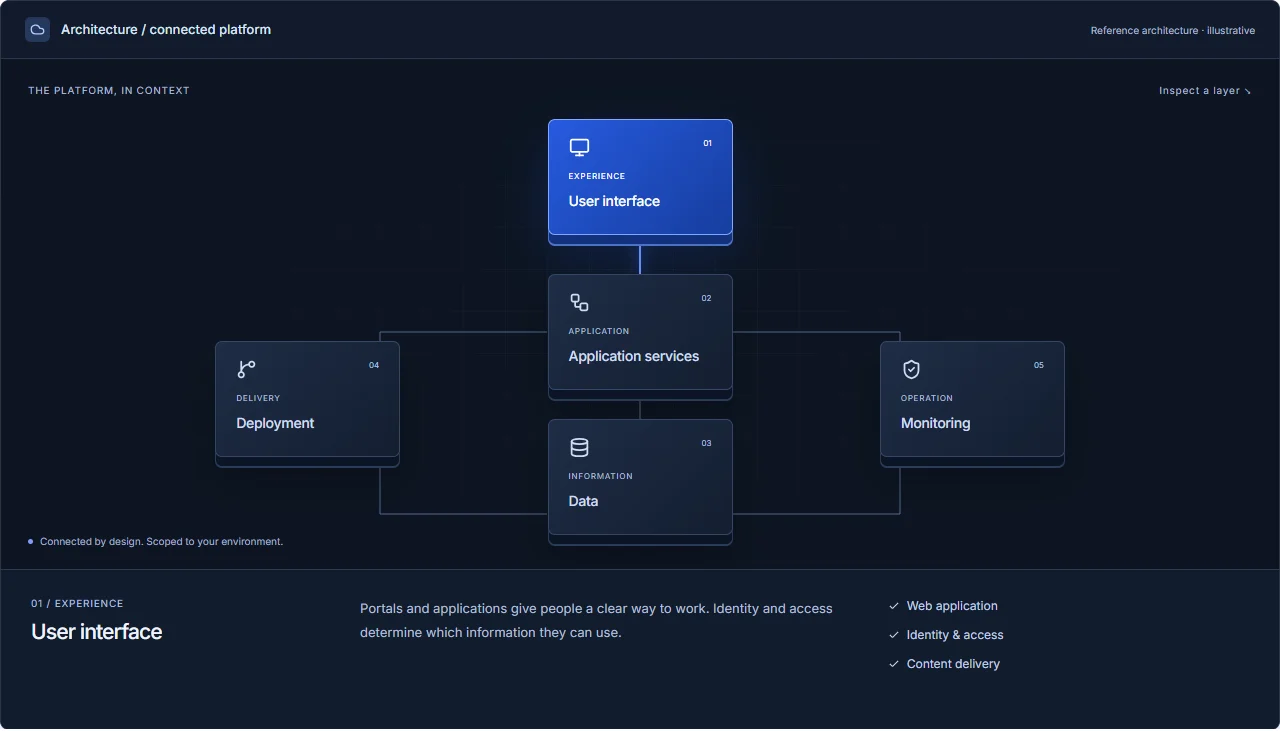
Environment differences appeared late in delivery. Deployment knowledge lived with a few people, and recovery procedures had not been exercised consistently. Every release carried avoidable uncertainty.
The scenario needed a repeatable delivery foundation that existing teams could adopt incrementally. It did not assume a full cloud migration, an instant reliability guarantee, or a new operating team.
Map workloads, environment differences, release responsibilities, and current recovery assumptions. Define acceptance for deployment, observability, and handover before choosing the implementation detail.
Describe infrastructure and configuration in version-controlled definitions. Separate environment-specific values and secrets, and review changes through the same delivery process as application code.
Build a pipeline that validates an artifact, promotes it through agreed environments, and records the release decision. Make failures visible and establish a practical rollback procedure.
Exercise the release and recovery workflow with the operating team. Add health signals, document escalation responsibilities, and transfer the procedures through a supported handover.
Simulated comparison for a standard environment in this scenario.
A consistent promotion workflow shared by the pilot teams.
An illustrative validation plan, not a production reliability claim.
For a real release programme, track deployment lead time, change failures, recovery time, environment drift, and operating cost. Set reliability objectives against the workload and commercial agreement.
A platform should make the safe path easier to follow. Repeatability is useful when teams can understand, operate, and improve it without relying on undocumented steps.
Explore cloud platformsYour systems, priorities, and constraints will be different. That’s where the conversation starts.