Map the work, including the exceptions
Trace a supplier request from submission to activation. Identify required information, decision owners, duplicate checks, and the points where work stops. Agree a baseline before introducing the new workflow.
A model for replacing fragmented supplier onboarding with a shared operational workflow—without replacing the core business system.
Discuss a similar challengeA multi-site manufacturer with purchasing, finance, and operations teams working across separate tools.
12-week illustrative delivery
Supplier onboarding & approvals
Fictional engagement. All figures are simulated or illustrative design targets; they are not verified client results.
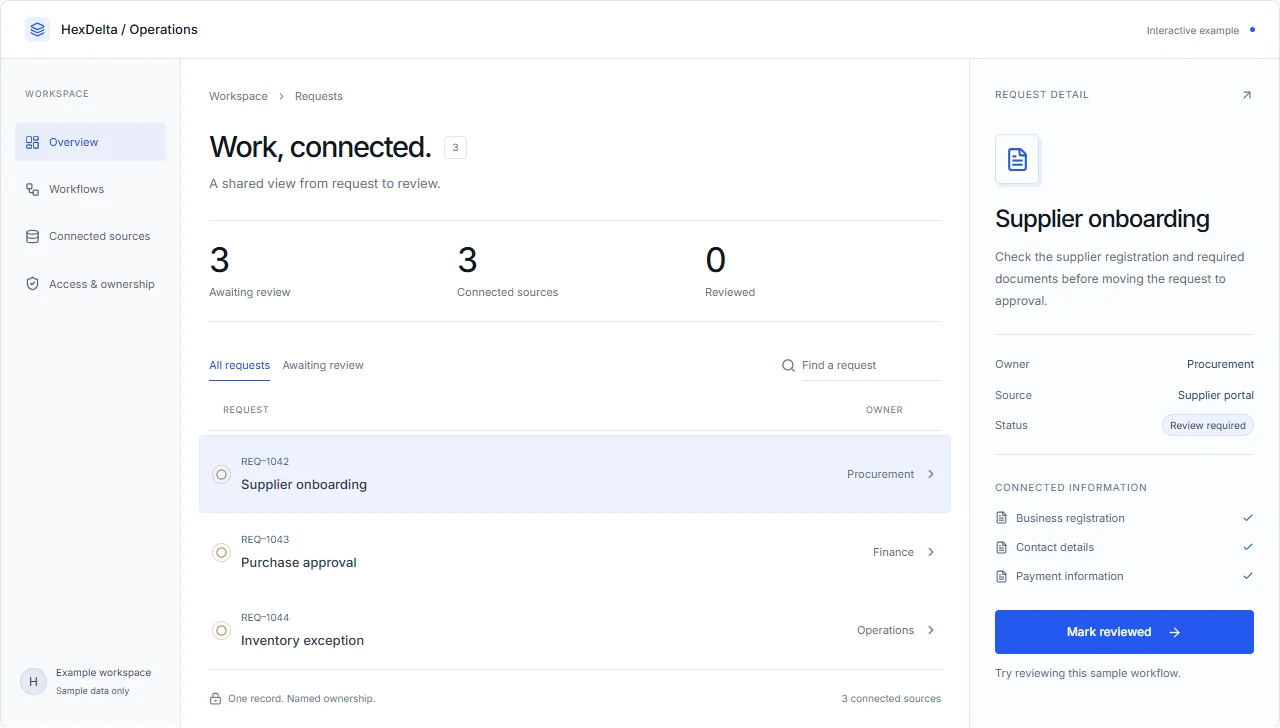
Supplier requests arrived through email and spreadsheets. Each team kept its own status, and the next person in the process often had to ask for information that had already been supplied.
The core enterprise application remained essential to purchasing. Replacing it was outside the scenario's scope. The challenge was to create a dependable workflow around it, preserve existing responsibilities, and make exceptions visible.
Trace a supplier request from submission to activation. Identify required information, decision owners, duplicate checks, and the points where work stops. Agree a baseline before introducing the new workflow.
Design a role-based portal with a single request history, explicit states, and a clear next action. Add validation at entry and an exception queue rather than allowing incomplete records to disappear into email.
Connect approved records to the purchasing system through an API layer. Use idempotent operations, retry handling, and reconciliation so a temporary integration failure does not silently lose a request.
Release to one operating group, compare workflow records with the core system, and resolve edge cases. Expand only after users accept the important tasks and the operating team can support the workflow.
Simulated median for complete requests in the pilot scenario.
Illustrative before-and-after process count.
A design outcome: one record of status, ownership, and decisions.
In a real engagement, compare complete-request approval time, rework, exception volume, and reconciliation failures against an agreed baseline. Validate the effect with actual users before wider rollout.
Modernization does not always begin with replacement. A well-defined workflow and integration boundary can address operational friction while keeping an essential system in service.
Explore enterprise engineeringYour systems, priorities, and constraints will be different. That’s where the conversation starts.