Define the questions worth answering
Choose a bounded set of operational questions with subject experts. Establish representative queries, expected source material, and examples where an assistant should decline to answer.
An illustrative approach to making approved operational guidance easier to find, with source references and a clear human review boundary.
Discuss a similar challengeA distributed service organization whose delivery teams rely on policies, operating guides, and frequently updated internal documents.
8-week illustrative pilot
Internal knowledge assistance
Fictional engagement. All figures are simulated or illustrative design targets; they are not verified client results.
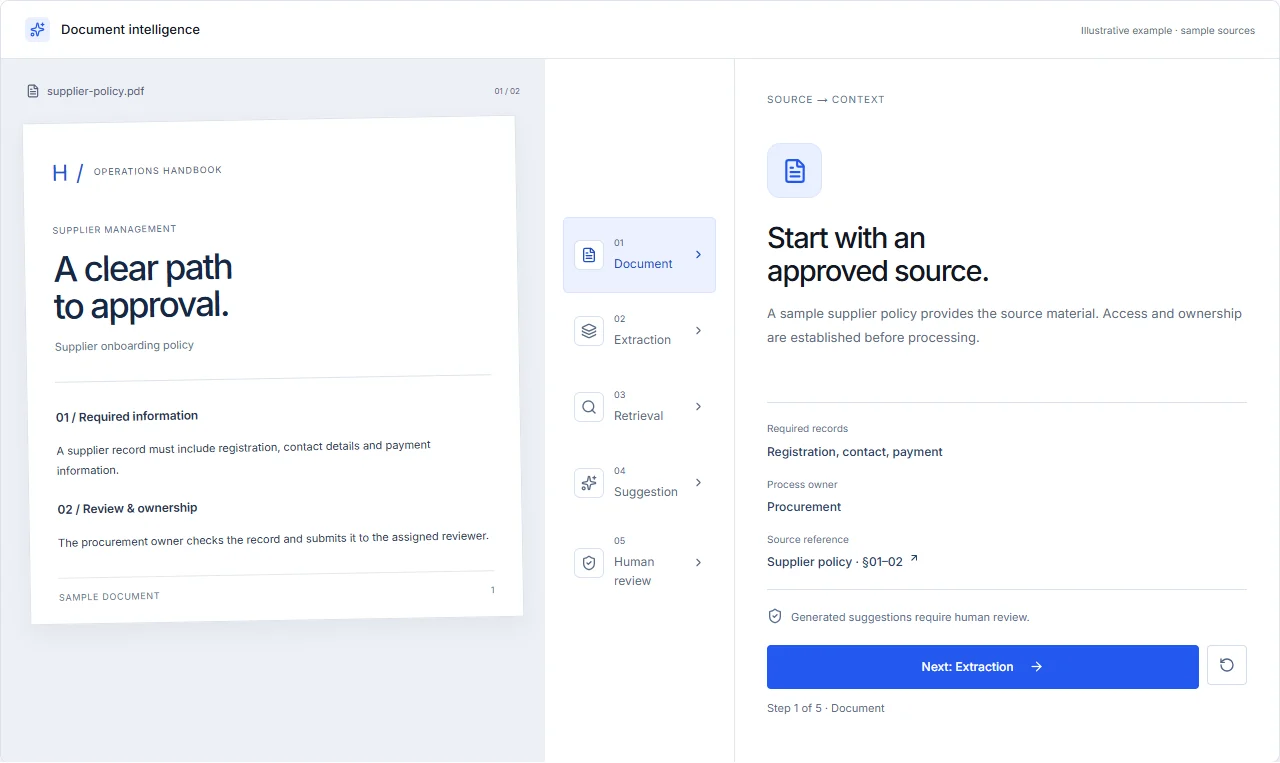
Useful guidance existed, but people searched across document stores, asked colleagues, and sometimes relied on an outdated copy. An answer without the right context could create more work than it saved.
The scenario called for a narrow knowledge assistant, rather than autonomous decision-making. Approved documents, source permissions, and a named review process were prerequisites for the pilot.
Choose a bounded set of operational questions with subject experts. Establish representative queries, expected source material, and examples where an assistant should decline to answer.
Identify current documents, remove superseded copies from the pilot collection, and record owners and review dates. Retrieve only information that the requesting user is permitted to access.
Present a suggested answer alongside the supporting passages and source version. Give users a way to identify a weak answer and route it for subject-matter review. Keep operational action outside the assistant's scope.
Assess source relevance, answer support, access behavior, and refusal quality. Review failures with the subject experts, then decide whether to improve, extend, or stop the pilot.
Simulated median across the pilot's representative tasks.
An illustrative acceptance requirement, not a measured client result.
A deliberate scope boundary: people review consequential outputs.
In a real pilot, compare task completion time, supported-answer rate, false assurance, access violations, and review effort. Do not treat source-link coverage alone as proof that an answer is correct.
The value of an enterprise AI workflow comes from the information, controls, and evaluation around it—not simply from producing a fluent answer.
Explore applied aiYour systems, priorities, and constraints will be different. That’s where the conversation starts.